SHTF INFO Alternative Energy

Summary
This report is one in a series of emergency technology
assessments sponsored by the Federal Emergency Management
Agency (FEMA). The purpose of this report is to develop
detailed, illustrated instructions for the fabrication,
installation, and operation of a biomass gasifier unit (i.e.,
a producer gas generator, also called a wood gas generator)
that is capable of providing emergency fuel for vehicles,
such as tractors and trucks, in the event that normal
petroleum sources were severely disrupted for an extended
period of time. These instructions have been prepared as a
manual for use by any mechanic who is reasonably proficient
in metal fabrication or engine repair. This report attempts
to preserve the knowledge about wood gasification that was
put into practical use during World War II. Detailed,
step-by-step fabrication procedures are presented for a
simplified version of the World War II, Embowered wood gas
generator. This simple, stratified, downdraft gasifier unit
can be constructed from materials that would be widely
available in the United States in a prolonged petroleum
crisis. For example, the body of the unit consists of a
galvanized metal garbage can atop a small metal drum; common
plumbing fittings throughout; and a large, stainless steel
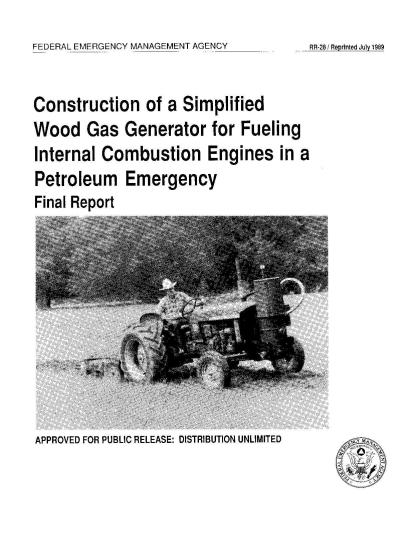
mixing bowl for the grate. The entire compact unit was
mounted onto the front of a farm tractor and successfully
field tested, using wood chips as the only fuel. Photographic
documentation of the actual assembly of the unit as well as
its operation is included. CONTENTS ABSTRACT EXECUTIVE
SUMMARY S.1. PRINCIPLES OF SOLID FUEL GASIFICATION S.2. THE
STRATIFIED, DOWNDRAFT GASIFIER 1. WHAT IS A WOOD GAS
GENERATOR AND HOW DOES IT WORK? 1.1.INTRODUCTION
1.2.PRINCIPLES OF SOLID FUEL GASIFICATION 1.3.BACKGROUND
INFORMATION 1.3.1.The World War II, Embowered Gasifier
1.3.2.The Stratified, Downdraft Gasifier 2. BUILDING YOUR OWN
WOOD GAS GENERATOR 2.1. BUILDING THE GAS GENERATOR UNIT AND
THE FUEL HOPPER 2.2. BUILDING THE PRIMARY FILTER UNIT. 2.3.
BUILDING THE CARBURETING UNIT WITH THE AIR AND THROTTLE
CONTROLS 3. OPERATING AND MAINTAINING YOUR WOOD GAS GENERATOR
3.1. USING WOOD AS A FUEL 3.2. SPECIAL CONSIDERATIONS AND
ENGINE MODIFICATIONS 3.3. INITIAL START-UP PROCEDURE 3.4.
ROUTINE START-UP PROCEDURE 3.5. DRIVING AND NORMAL OPERATION
3.6. SHUTTING DOWN THE GASIFIER UNIT 3.7. ROUTINE MAINTENANCE
3.7.1 Daily Maintenance 3.7.2 Weekly Maintenance (or every 15
hours of operation) 3.7.3 Biweekly Maintenance (or every 30
hours of operation) 3.8. OPERATING PROBLEMS AND TROUBLE
SHOOTING CONTENTS 3.9. HAZARDS ASSOCIATED WITH GASIFIER
OPERATION 3.9.1. Toxic Hazards 3.9.2. Technical Aspects of
Generator Gas, Poisoning 3.9.3. Fire Hazard APPENDICES
APPENDIX I. CONVERSION FACTORS FOR SI UNITS APPENDIX II. LIST
OF FIGURES APPENDIX III. LIST OF TABLES APPENDIX IV.
BIBLIOGRAPHY There are plenty of resources for further review
as well. The plans in this reference material are for shorter
term use and emergency use. The material provides an
excellent foundation so that one can gain an understanding of
how wood gas generators operate and how to build one. This is
a must read for anyone who likes to be prepared in case of
emergencies and for anyone looking to increase their
knowledge regarding alternative energy resources. An
excellent reference resource. **
Tags: Alternative Energy
Added: March 8, 2014